Average exposure score
The core country-conditioned task scores are close.
India1.386
Viet Nam1.343
Comparative diagnostic
Two lower-middle-income Asian economies sit close on the core task benchmark, but not on the goods-side layer.
India and Viet Nam sit close on the country-conditioned task benchmark. Both are substitution-leaning rather than augmentation-heavy, and both surface administrative, clerical, and information-handling work near the top of the atlas. But the trade-facing layer is not the same: Viet Nam is far more exposed through the goods-side proxy and far more open in goods trade.
What do we learn when two countries sit close on the core task-exposure benchmark, but differ sharply once we shift to the trade-facing layer?
At a glance
At the headline level, India and Viet Nam sit near one another on the country-conditioned task benchmark. India's average exposure score is 1.386, compared with 1.343 in Viet Nam. The high-exposure shares are also close: 10.3% in India and 8.7% in Viet Nam. This is exactly the kind of pairing where a simple ranking is not enough. The relevant question is what stays similar beneath the average, and where the structure starts to separate.
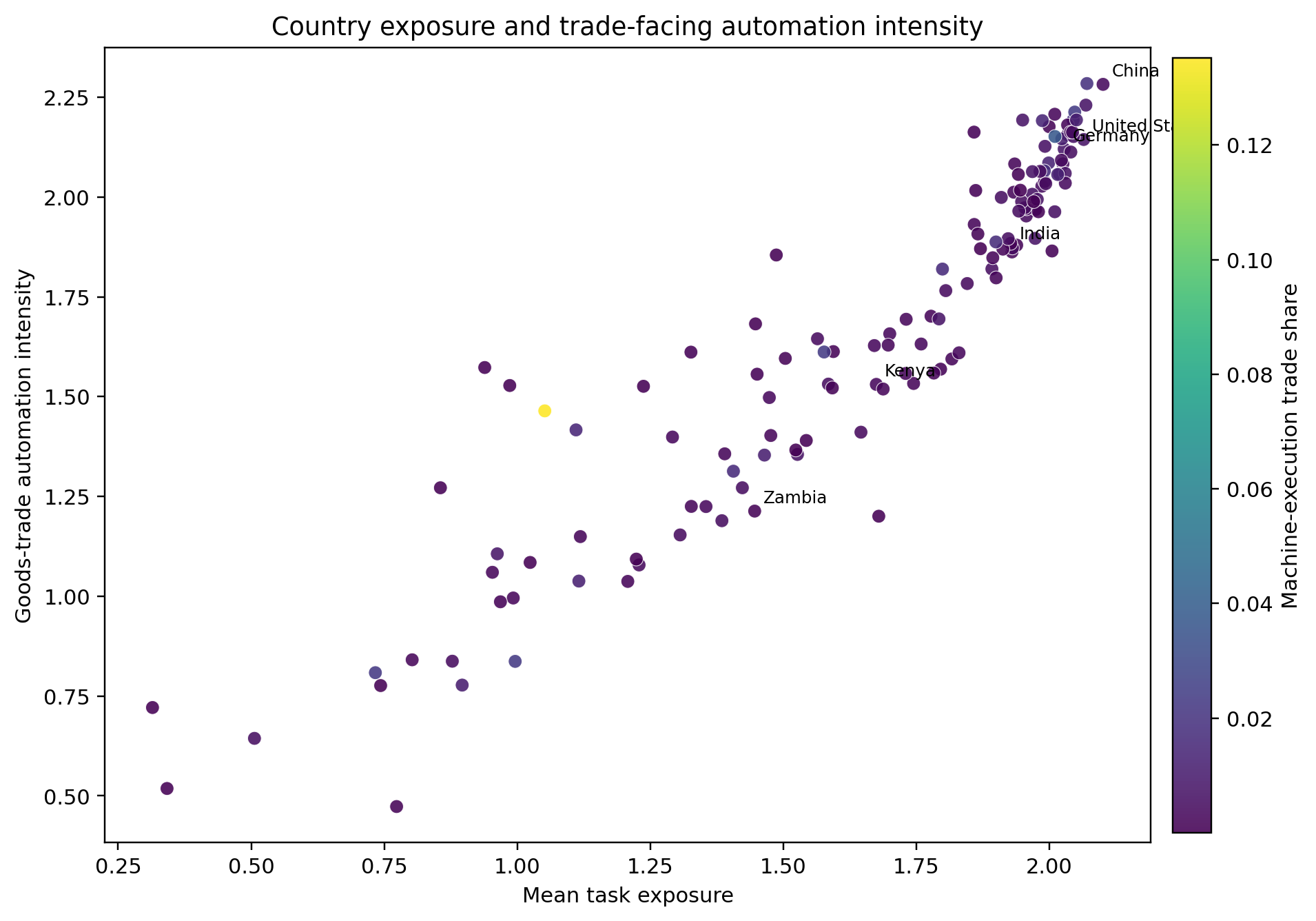
Trade-facing proof point
The goods-side layer is not a duplicate of the task benchmark. It reveals where similar task exposure sits inside very different trade and production structures.
Why the average is not the whole story
The task story remains close even after we move beyond the average. Both countries lean more toward substitution than augmentation, and the balance is almost identical: 0.136 in India and 0.136 in Viet Nam. The top occupations and skills also point toward a similar family of work. Administrative routines, bookkeeping, document handling, scheduling, and transactional service tasks all appear near the top. So the first useful lesson is that the core task layer is not where these countries separate most strongly.
Where the signals separate
The goods-side proxy tells a more differentiated story. Viet Nam's goods-facing automation exposure is 1.759, compared with 1.397 in India, and the difference in goods trade openness is far larger still. Viet Nam is much more deeply integrated into goods trade and has a much larger manufacturing share of output. That means two countries can sit close on the core task benchmark while still facing very different descriptive exposure through traded goods and production structure.
India
Viet Nam
What to remember
The main lesson is not that one country is exposed and the other is safe. The more useful lesson is that similar task exposure can coexist with different forms of economic integration. India and Viet Nam both surface clerical and information-handling work on the task side, but Viet Nam's stronger goods-trade integration means the trade-facing proxy becomes much more salient. That is exactly why the atlas includes both the country-conditioned task benchmark and the specialist goods-side layer.
India and Viet Nam sit close on average exposure, high-exposure share, and substitution balance.
The top occupations and skills in both countries point toward administrative, accounting, and record-handling tasks rather than completely different task worlds.
Viet Nam is much more open in goods trade and much more exposed on the goods-side automation proxy, so similar task exposure does not imply similar goods-facing integration.
What to compare next
The comparative diagnostics should open back out into the atlas rather than end on a single story page. These are the most useful next steps from this pair.